








Centipede
- Developer: Atari
- Publisher: Atari
- Release Date: 1981
- Original Platform: Arcade
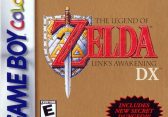
- Version Played: Arcade Classic No. 2 (GB, 1995)
Continuing on with the theme…
Centipede was designed by Ed Logg and Dona Bailey. Bailey is credited as being one of the first few female game programmers in the industry. She joined Atari’s coin-op division in 1980 and was not only the only female software engineer at Atari, but also the only woman there at all.
According to Logg, the game was intended to attract more woman players. Bailey wanted the game to have a distinct and visually arresting look, citing an inspiration in pastels. The game sported bright attractive colours that would alternate between stages. The pair succeeded and the game, like Pac-Man before it, had a significant female player base.
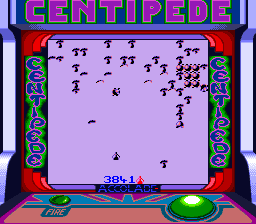
Inspired by Space Invaders, the game is simplistic yet addictive – easy to approach and a lot of fun to play. Seriously. I played a lot of this in preparing this piece. It’s not just a shooter. Shooting isn’t the key. Imagine Pac-Man as a shooter and you have a better idea. To succeed in Centipede, you need to observe and react.
The player, controlling the “Bug Blaster”, defends against centipedes, spiders, scorpions, and fleas, completing a round after eliminating the centipede’s body that winds down the playing field through a multitude of mushrooms. You can travel the width of the screen and about one third of the way up or thereabouts.
An interesting aspect of the game is that, when shot, the centipede will split up into multiple body segments – each with its own head and that move independently of one another. Eventually you whittle down the broken creature to just a single head, especially difficult to target as the game gets faster.
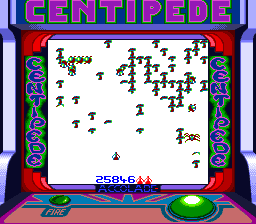
Besides the titular centipede, all of the other enemy insects in the mushroom forest have their own behaviours and patterns. Spiders jump around and occasionally eat mushrooms. This is a problem because fleas will appear when there are too few mushrooms present on the map. They dive-bomb and drop mushrooms along the way. The scorpion will poison every mushroom it comes across and if a centipede head touches a poison mushroom, he is driven mad and promptly dives down towards the bottom of the screen instead of winding its way through the forest as usual.
I played the 1995 Game Boy release developed by The Code Monkeys and published by Nintendo. Which itself was an adaptation of Accolade’s earlier Game Boy port from 1992 – except that The Code Monkeys also added the sequel, Millipede, making for a compilation release. Oh and they included some Super Game Boy necessities like arcade borders and colouring effects that, like the original game, will alternate between stages. Eventually, Majesco picked up this version and released the games separately, removing the Super Game Boy effects in the process.
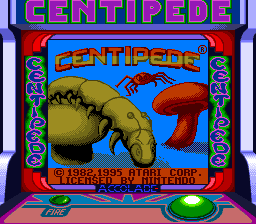
I haven’t played any other version than the Game Boy one, and I’ve read some poor things about it compared to superior home console releases. But, it’s all I know and I trust Nintendo as publisher, and I am a sucker for Super Game Boy gimmicks. And I had a blast playing the game, so there.
Defender
- Developer: Williams Electronics
- Publisher: Williams Electronics
- Release Date: February, 1981
- Original Platform: Arcade
- Version Played: Williams Arcade’s Greatest Hits (Sega Genesis, 1996)
I’m going to be honest, I did not enjoy this game at all. I don’t think I like any of the arcade games that came out of Williams Electronics. They look weird, they feel weird. I find them too challenging, perhaps designed to eat quarters I suppose. They have not aged well in any way imaginable. Nevertheless, let’s discuss the game, shall we?
Williams was originally a pinball machines manufacturing company. In 1973, they branched out into arcade games with their PONG clone titled “Paddle Ball”. Unfortunately returning the industry back to popular space shooters in the process, heavily inspired by Space Invaders and Asteroids, Williams released their first original work – Defender in 1981.
The game made several breakthroughs despite the derivative source material. A lot of thought went into this game, so much so that to me it feels very convoluted. The team, lead by pinball programmer Eugene Jarvis, strived to create new gameplay mechanics. They were clearly ambitious. They wanted a large world that felt like it was expanding far beyond the limits of the screen, so that’s what they did. The screen will scroll horizontally, in either direction, which causes the game to play as if a very large version of Space Invaders was rotated 90 degrees. Every game I have played on this journey until now has been a single screen that would reload so-to-speak once you’ve cleared it. The novelty of having a game that broke beyond the borders of the screen was a great advancement. The birth of side-scrolling and it wasn’t from a platformer.
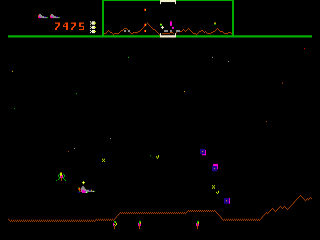
Jarvis also felt that the game required a recognizable objective. Hence the name – “Defender”. Looking at other space shooters, survival was clearly a critical and reoccurring element to success. But whose survival was turned on its ear with this game. Guess what, there are these invaders from space (wink, wink), but they’re not just invading – they are abducting humanoid astronauts from the planet’s landscape! Once abducted by the Landers, your astronaut companions become alien mutants that attack you and your spaceship – the Defender. Rescue the astronauts, defeat the aliens, and restore the planet.
There are a variety of alien enemies in this game all with different attack patterns and purposes – Landers, Swarmers, Baiters, Bobers, Pods, and Mutants. I don’t think I ever made it far enough to actually see most of them though. To control your spaceship in addition to your basic movement you can also thrust, reverse, fire, use a limited amount of smart bombs that will destroy everything on the screen, oh, and you have the Hyperspace ability from Asteroids inexplicably. Like in Asteroids, there is no control over where Hyperspace will warp you.
Also unique to this game is the scanner in your HUD, which displays an overview of the entire planet. You see where you are, where the astronauts are, and where the aliens are. This allows you to focus on the portion of the map you’re currently on, but also keep abreast of what may be happening off screen. It is all very fast-passed and there are some fancy particle effects to the explosions.
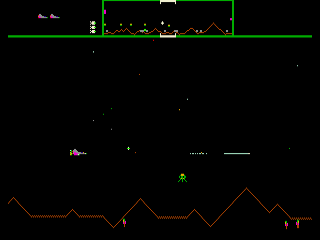
There’s a lot of thought that went into this game. Some significant technical progress was made. I just didn’t enjoy it unfortunately.
Also, shout out Digital Eclipse who developed the compilation release I played this on. I may not enjoy the games, but they were very accurate ports. This is kind of their thing, having released several quality and accurate compilations over the years for Williams, Atari, Capcom, Midway, Namco, and the like. If you ever feel like getting your toes wet with the works of a certain studio from the early days, you would do well to seek out the Digital Eclipse compilation release.
Route-16
- Developer: SunSoft and Tecmo
- Publisher: Centuri
- Release Date: May, 1981
- Original Platform: Arcade
- Version Played: Route-16 Turbo (Famicom, 1985)
Good bye, space! No more space games for the rest of this article. Huzzah! This is a racing game about the “route” of all evil – money. Cars speed around maze-like rooms trying to secure bags of money before their opponents do.
I played the “Turbo” version on the Famicom, which acts as an updated port of the arcade original with improved graphics and audio as well as an adjustable difficulty setting.
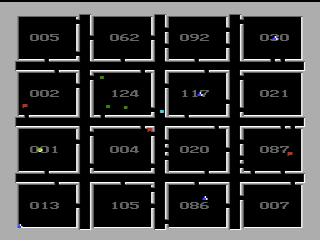
The main map is divided into sixteen blocks that you must visit and travel around. Each block serves as a short maze. When you enter a block, you navigate its maze while dodging combatants and obstacles and collecting money and other items along the way. Always keeping your eye on your fuel level, you can turbo boost out of harm’s way if need be. Collecting a flag will reverse the tables, Pac-Man style and you can chase the enemy cars and try to get them to crash. In this way, the game clearly takes inspiration from two of Namco’s hit arcade games; namely Pac-Man and 1980’s Rally-X.
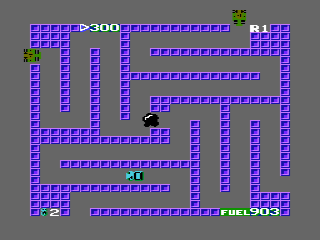
The game is fun and simple. But I was impressed with two key aspects of the game in particular:
- I have an overworld map to explore! Zoomed out as it is, it shows at a glance where there’s loot to be had as well as the location of your car and the opponent cars as everyone manoeuvres across the map and through the grid of maze blocks to explore. It’s an improvement over Defender’s tiny radar feature.
- The screen changes! Defender gave us a big screen, but this Route-16 gives us many multiple screens. Each block maze is unique and feels like a self-contained task. It isn’t quite there yet as they’re so brief, but they feel a bit like levels. Multiple levels, not just one screen repeated uhh…. repeatedly.
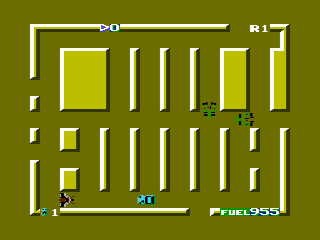
You get the hang of it pretty quickly and when you try to put it down you will likely pick it up again for one more try of the fast paced action. Also, this game has some really catchy music going on loop.
Frogger
- Developer: Konami
- Publisher: Konami / Sega-Gremlin
- Release Date: June, 1981
- Original Platform: Arcade
- Version Played: Sega Genesis, 1998
Fun fact: Konami was originally going to name the game “Highway Crossing Frog”. Sega, however, desired the name to be something more unique so it was named “Frogger”.
The jukebox repair turned video game company Konami may today be synonymous with the likes of Castlevania, Metal Gear, or Silent Hill but Frogger is clearly not that. The game’s style rides on the success of Namco’s Pac-Man before it. Video games, and their cutely designed mascots in particular, were now becoming part of popular culture. This freed up developers to leave outer space and start to become more creative with their designs.
Oh and having a catchy and marketable character was profitable if the game was a hit, of course. Frogger, like Pac-Man before it, became the basis for a kitschy novelty pop song in the early 80s called “Froggy’s Lament”. The famous amphibian was also a reoccurring character on CBS’ Saturday Supercade – an arcade themed Saturday morning cartoon show. Oddly, Frogger here was depicted as a reporter for the fictional Swamp Gazette newspaper. Toys, board games, t-shirts, 7-Eleven Slurpee cups – Frogger managed to hop its way into popular culture.
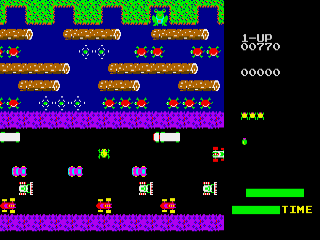
You know the game. You guide a frog through traffic, then across an infested river, and lastly to the habitat enclosures on the other side. Cars, trucks, buses, dune buggies, bulldozers, taxis, crocodiles, diving turtles, otters, and snakes are all out to get this little frog. No buttons, no attacks, no power ups, just movement. Do all of this without get splattered on the highway, eaten, or drowning in the river…. because frogs can’t swim apparently???
There is nothing really innovative or unique here. The music is catchy and continuous though and perhaps novel for the time the music will change contextually a bit based on what your frog is doing. I haven’t encountered that yet from what I’ve played so far.
Navigate from the bottom of the screen to the top of the screen, navigating the frog between obstacles and protecting Frogger from becoming road kill. Eat flies. Rescue lady frogs off of logs in the river. It’s not easy being green.
The version I played was a very accurate port for the Sega Genesis done by Hasbro Interactive. This came out in the midst of Frogger’s brief revival in the late 90s once Hasbro licensed the rights from Konami and released a series of remakes and sequels. This same year also happens to be when the Frogger episode of Seinfeld aired. Stay away from the Super NES version of this port as the music is removed and replaced with annoying sound effects. In addition, the visuals are completely redone to look like a freeware DOS game.
Donkey Kong
- Developer: Nintendo
- Publisher: Nintendo
- Release Date: July, 1981
- Original Platform: Arcade
- Version Played: NES, 1983
“It’s on like Donkey Kong”
Donkey Kong is a very early example of the platformer, with the gameplay focusing on manoeuvring and jumping Mario across a series of platforms while avoiding enemies and obstacles. As Mario, you scale the construction site of crooked girders, ladders, and conveyor belts. You jump over and hammer barrels, fireballs, flaming oil barrels, bouncing spring weights, and cement pans as you make your way towards the great ape.
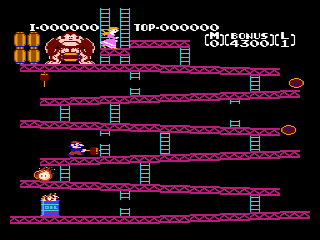
The game itself is notable for being the latest (and quite possibly would have been the last) effort by Nintendo to enter the North American arcade market. It is also the first game that was spearheaded by legendary video game designer, Shigeru Miyamoto. Miyamoto was hired as the company’s first staff artist, creating artwork for some of Nintendo’s early arcade games. 1979’s “Radar Scope” was the first game that Miyamoto actually helped to develop.
Radar Scope was pretty popular in Japan at the time, so much so that Minoru Arakawa, the first president of the then newly founded Nintendo of America, placed an incredibly large order for it with the hopes of breaking into the North American market. Unfortunately, months had passed by the time the game had arrived and the buzz surrounding it had since dissipated. Nintendo of America was stuck with thousands of unsold units sitting in their warehouse.
In response, Nintendo CEO Hiroshi Yamauchi assigned Miyamoto with developing a new game that would primarily target the North American market and could be easily installed as a replacement in the existing Radar Scope arcade hardware through conversion kits.
Drawing from a wide range of inspirations, including Popeye, Beauty and the Beast, and King Kong, Miyamoto developed the scenario and designed the game alongside Nintendo’s chief engineer, Gunpei Yokoi, acting as supervisor. Miyamoto imagined many characters and plot concepts, but eventually settled on a love triangle between a gorilla, a carpenter, and a girl. Mario must rescue his girlfriend Pauline, the damsel in distress, from his mistreated giant pet ape Donkey Kong. Donkey Kong the game marked the first time that the formulation of a video game’s storyline preceded the actual programming.
When the new game was sent to Nintendo of America for testing, the sales manager disapproved of its vast differentiation from the “maze chase” and “shoot ’em up” games that were popular at the time. Despite the unusual concept and their initial doubts, Donkey Kong, went one to become one of the most important titles from the Golden Age of Video Arcade Games, and became one of the most popular and successful arcade games of all time. It was a commercial and critical hit in both North America and Japan and is credited as being Nintendo of America’s saving grace. Never mind launching two of the most popular and recognizable characters in gaming.
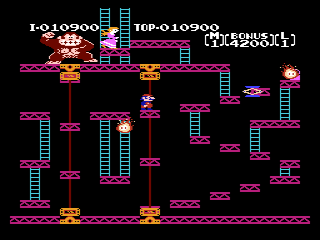
It was a major breakthrough for Nintendo and the video game industry at large. Moreover, the novel platforming gameplay helped to distinguish it from the sea of common maze and shooter games Nintendo of America was hoping for. The game’s characters became familiar fixtures on cereal boxes, television cartoons (joining Frogger on the Saturday Supercade), board games, pyjamas, comics, Jenga, and countless other merchandising opportunities. Besting Pac-Man and Frogger before it, Donkey Kong saw two songs written about it. The game even appeared on an episode of Mister Rogers’ Neighborhood, where Mister Rogers learns how to play the game. Won’t you be my neighbour, Donkey Kong?
Miyamoto and Yokoi broke new ground in the industry by effectively utilizing graphics and animation as a means of characterization, including cutscenes to advance the game’s plot, and integrating multiple stages into the gameplay. With four unique stages, Donkey Kong was the most complex arcade game at the time of its release. The four stages combine to form a level. Upon completion of the fourth stage, the level increments and the stages repeat with increasing difficult.
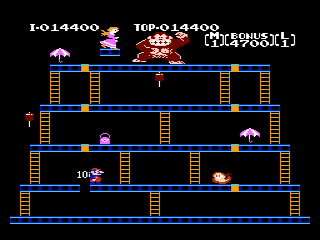
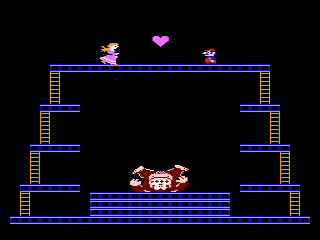
Donkey Kong is considered to be the earliest video game with a storyline that visually unfolds on screen. While Pac-Man featured brief cutscenes as humours intermissions in-between some of the levels as comic relief, Donkey Kong tells a story. Donkey Kong, the clear villain in the tale, smirks when Mario fails. Pauline cries for “HELP!” through a speech bubble. Mario, the hero, is the everyman character. The game opens with the big ape climbing up a construction site with Pauline in his clutches. Upon reaching the top, he stomps his feet cause the steel beams and girders of the construction site to break – creating obstacles for our would-be hero, Mario. Upon reaching Pauline on each stage, a heart appears between her and Mario but Donkey Kong grabs her and climbs even higher still – causing the heart to break.
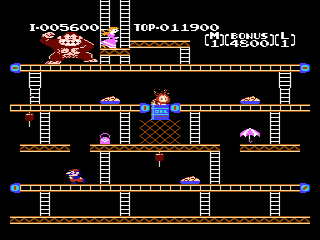
I played 2010’s “Original Edition” of the 1983 NES port of the 1981 arcade game. The game was ported by Intelligent Systems (best known today for Fire Emblem, Advance Wars, and Paper Mario) as a Famicom launch title and appears to have been limited by an early understanding of the technology. Several screens, certain animations, and even the entire second stage are missing. Considering the arcade game only has four levels, that’s kind of a biggie. The “Original Edition” is a revision of the NES port to restore some of these features (the “How High Can You Get?” scene is still absent, sadly) and was released on the Wii as part of the “Super Mario Bros. 25th Anniversary” followed later by a release on the 3DS. In the absence of the actual arcade game being available on the eShop, it’s the version you should try to get your hands on.
It may be a bit bizarre, but the game has a compelling narrative hook, memorable music, and colourful, cartoony graphics that have aged gracefully.
Each of these individual titles in the golden age of arcade video games influenced the next major release that followed it. From the creation of genres, to improvements in graphics and music, to featuring multiple levels, to the commercialization of gaming characters, to the use of multiplayer, to the use of HUDs and maps, to the birth of storytelling in video games, and so on these games lay the foundation for the industry. They inspire developers and players alike to continually push the industry forward and try something new.

Retro Rewind: 1982

That was a very informative and fun read. I think the takeaway point from this article is the importance of the mascot. PAC-MAN, Donkey Kong, and Mario are still here today, while the other games (although successful at one point) have faded away somewhat. As you said, even Frogger (no way near as popular as PAC-MAN, DK, or Mario but a mascot nonetheless) became the basis for a pop song.