









We here at 4P Games really love video games. We play them a lot, and if you’re here reading this, then chances are that you do too. We were all introduced to gaming at different times in our lives and at different points in the history of the industry, but we all share a fondness for the medium.
By some accounts, we are currently in the middle of the eighth generation of video games. Eight! There’s quite a history there. From the first electronic game way back in 1947 to Pong popularizing arcade video games in 1972, I find it rather interesting and even important to look back at how far we’ve come.
But, let’s be honest, that far back is a little dry. This is the first entry in a new series here entitled “Hardware Highlights” (serving as a companion to another upcoming game-centric series I’ll be working on entitled “Retro Rewind”) where I’ll be looking back at some of the video and handheld game consoles from our youth. To examine the motives behind the gadgets we grew up on that supplied us with such childhood joy and how they’ve left their mark on the industry.
With that in mind, I can think of no greater starting point than the Nintendo Entertainment System. Its Japanese counterpart, the Famicom, celebrated thirty years last year, and the NES will hit that milestone next October. It is a platform with a cherished legacy. Gamers look back on those days fondly; dripping with nostalgia. But it is not just thanks to rose-coloured glasses, it is well deserved.
Most importantly, of course, it was my first video game console; my introduction to the magic of gaming. Jumping ahead a bit to what’s technically considered the third generation of video games, but honestly it’s the first. It is arguably the most important platform. What was before doesn’t count. The NES was a reboot. Without it, we wouldn’t be here. It resurrected the industry.
So, let’s begin, shall we?

Nintendo revitalized the struggling video game industry with the 1983 release of their Famicom in Japan. Needless to say, this move was quite the gamble with the industry having crashed that same year. From 1983 to 1985 (when the NES launched in North America) the industry saw revenue drop by a whopping 97%! To understand why the NES was so successful, we’ll have to look where the industry first led astray because Nintendo consciously tried to address every fault in the market.
The video game crash of 1983 was the result of several negative contributors. To begin with, the console market was flooded with alternatives. It should be noted that there was a first, albeit short-lived, crash in 1977. The industry quickly recovered as the home video game market shifted away from what were essentially variations on Pong-playing clone machines and began creating home adaptations of popular arcade games. Competition was great, but there were simply too many options. Atari had two consoles, as did Coleco and Mattel, in addition to multiple other brands. And from those, several already had upcoming console iterations announced.
Each of these consoles had their own competing library of games. Massive third-party libraries of what ultimately amounted to… not really the greatest quality. Let’s just say the notorious E.T. game isn’t much of an outlier. There was a lack of talent and thought. This produced many developers and publishers popping up over night, making a quick game, without quality control, destined for the bargain bin. It damaged the perception of the industry and the medium.
Adding to this sense of competition was the increasing access to new-fangled home computers. They were faster and more powerful than video game consoles and, by extension, allowed for more interesting games – kind of like today, I suppose.
The economics at the time also hit the arcade industry in North America. A simple quarter didn’t go as far as it used to under inflation. Interestingly, arcades in Japan prospered and stabilized due to the use of ¥100 coins (the equivalent of $1 at the time, better than 25¢ in North America) and helped no doubt by great software from the likes of Namco, Sega, and Nintendo.
In short, the market was flooded with consoles and too many games. They were expensive and the quality was shoddy. It was a sullied medium; seen as a fad. Nobody was interested and no one was buying anymore. Stores tried to return their surplus, but the publishers were unable to refund and they folded. Going forward, video games were given less shelf space.
It was bad.
And yet, Nintendo determined in the midst of all of this that this was the perfect time to enter the home market, having already had a successful run of arcade games and their Game & Watch handheld line in Japan. And thank goodness they did.
Video games were trash. So, Nintendo set out to make a video game console that wasn’t a video game console. Or at least, wasn’t portrayed to be one. Why, just look at the name! In Japan, it was the “Family Computer”. In North America, it was an “Entertainment System”. The term “video game” was to be avoided at all costs. It wasn’t a “console”, it was a “control deck”. Software came on “Game Paks” instead of cartridges.
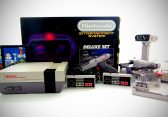
This was intentional branding on Nintendo’s part. The system was simultaneously supposed to appear as mature and yet a toy – like a VCR or cassette player. It was an essential entertainment device in your TV space, but at the same time it was great for kids. To be considered a video game playing device would have been a considerable barrier to success. The NES was ultimately originally released, in one configuration, with R.O.B. – the “Robotic Operating Buddy” – as a novelty accessory to help portray the system more as a toy.

The original plan for the Famicom was as a 16-bit system, called the “GameCom”, which could also function as a computer with keyboard and floppy disk drive (an idea later revisited through the Famicom Disk System in 1986). It was determined that a full-featured computer wouldn’t have the breadth required to appeal to a wide consumer base. It was too niche, too techy. Hiroshi Yamauchi, Nintendo’s president at the time, and Gunpei Yokoi, one of Nintendo’s major designers, decided to try a new approach.
Yokoi pioneered a hardware design philosophy he called “Lateral Thinking with Withered Technology”. Essentially, that focusing on cutting-edge technology isn’t a necessity, and that using mature and abundant technology in innovative ways can better produce more entertaining and quality gameplay. Pretty much what Nintendo’s philosophy remains today, for better or for worse. It has been in use throughout much of their hardware, but we’ll touch upon those in later instalments in this series. Throughout the Famicom’s research and development, the goal was to produce a competitively less expensive game console with performance that would not be surpassed for a few years.
While still innovative, it was decided to initially go with a more conventional (and cheaper) cartridge-based system. The Famicom was also equipped with a cartridge eject lever because the system’s designer, Masayuki Uemura, felt that children would be entertained by using it. Functionally, this feature was irrelevant and unnecessary but was part of the attempt to convey the system as a toy. While the lever didn’t make it’s way to the NES, we did ultimately see a similar idea with the release of the SuperNES. To further add to the Japanese toy aesthetic, the Famicom was painted red and white and the second controller (hard-wired in Japan) featured a microphone.
Similar to the GameCom, the NES was first unveiled in North America as the “Advanced Video Entertainment System”. The AVS was an ambitious, premium system again fashioned as a full computer – looking a bit like a sleek, monochrome VCR. Sporting a keyboard, cassette data recorder, wireless infrared joystick controller, BASIC programming utility, and numerous accessories, it, like the Famicom, was eventually scaled back significantly before release following the principles of “Lateral Thinking with Withered Technology”. We ended up with the 8-bit cartridge-based system, as redesigned by Lance Barr, that we know and love today.

Perhaps the finest example of how Yokoi’s philosophy was put to use was with the absence of joysticks, which were standard input devices at the time. It was felt that the durability of joysticks was not ideal for a child-friendly system. As a result, the concept of using a joypad or “D-pad” was borrowed from some of Nintendo’s Game & Watch titles like “Donkey Kong”. The combination of the cross-shaped D-pad and four-button layout was found to be comfortable to hold and easy to use when compared to bulkier joystick based controllers. The controller is iconic today and its impact can still be seen in the controllers of all the major players today.

Retro Rewind: 1982

Retro Rewind: From Pong to Kong
