









Millipede
- Developer: Atari
- Publisher: Atari
- Release Date: 1982
- Original Platform: Arcade
- Version Played: Arcade Classics No. 2 (GB, 1995)
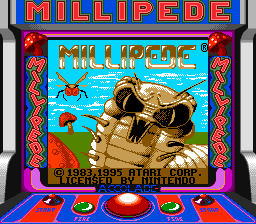
You may recall that in a previous entry of Retro Rewind I was quite praiseworthy of Centipede. Here, we take a look at Centipede‘s derivative sequel, Millipede.
Maybe “sequel” isn’t the best way to phrase it. The game plays like “Centipede – Game of the Year Edition,” more refined and sporting a couple new enemies and other gameplay elements. It’s a more frantic and random variation of the original game and I’m not entirely sure it’s better for it.
No input from Dona Bailey this time around, this is strictly an Ed Logg affair. Centipede proved popular, so much so that arcade gamers began to pick up on the patterns within the game. This eventually led to longer play sessions and ultimately less coinage for arcade purveyors. Satisfying cravings of fans for a sequel and arcade operators for a game that eliminated the predecessor’s predictability, Atari released Millipede – originally planned to be called Centipede Deluxe.
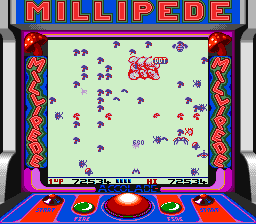
Millipede introduces new enemy insects to the game, including an inchworm that will briefly slow down the game’s speed if shot. Also new in this game is an exploding dichlorodiphenyltrichloroethane bomb. To reduce the predictability of the game, Atari introduced mushrooms that could be turned indestructible if passed by a beetle. The forest of the stage itself would also grow, decay, and adapt over time.
Like Centipede before it, the object of the game is to destroy a millipede that advances downward from the top of the screen. The millipede travels horizontally until it either hits an obstacle or reaches the edge of the screen, after which it drops one row and reverses direction. Once it enters the player’s manoeuvring area, it stays there and extra heads appear at intervals until both they and the millipede are destroyed. Shooting a body segment splits the millipede in two, with the rear portion sprouting its own head… which is rather horrifying if you think about it.
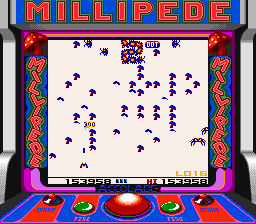
The game, in the advertising material for the original arcade version, also features a bizarre plot outline. You are a young royal who was offered the crown by the father before he passed. You refuse because you want your would-be subjects to be able to be free to live among nature. This enrages your kingly father before he croaks. Once he does, and you inherit the kingdom, he enacts revenge from beyond the grave by plunging the world into darkness and forcing the forest to overgrow with life and attack you and the populace. It’s supposed to be ironic, I guess. So, then you have to fight nature’s monstrous insects, which sucks.
I prefer the original game to this “Deluxe” version. As with Joust, sometimes simpler is nicer. That’s my theme here for 1982. New ideas work, bettering old ideas not so much. And gardening games appear to be a trend, but Dig Dug is better. I’m not big on the quarter munchers.
Like with Centipede, I played the 1995 Game Boy release developed by The Code Monkeys and published by Nintendo. It includes some Super Game Boy niceties like arcade borders and colouring effects that will alternate between stages.
Robotron: 2084
- Developer: Vid Kidz
- Publisher: Williams Electronics
- Release Date: 1982
- Original Platform: Arcade
- Version Played: Williams Arcade’s Greatest Hits (Sega Genesis, 1996)
Joust was an outlier, that rare game from Williams Electronics that I actually enjoyed. While this wasn’t developed by Williams proper, it was published by them and sports that trademark look – colourful, yet devoid of life, and lots of flashing just because.
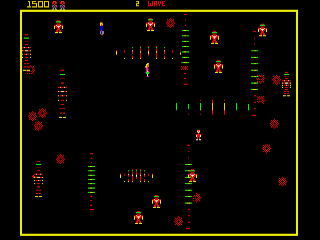
There isn’t much to this. It’s a top-down single-screen 2D shooter. Humans have a rough go in Williams’ games. In Defender, you were protecting space-bound human colonists from alien invaders. In Robotron, you’re protecting the remnants of the human race stuck on earth from their robot servants in the throws of a cybernetic revolt. Just like with humans, when robots unionize, bad things happen.
In the year 2048, we’ve perfected robotics and built a cybernetic species to server us. But we built them too well – they were perfect, too perfect. Humans were inferior and inefficient and the Robotrons recognized this.
You, inexplicably, have superhuman abilities. Naturally it falls upon you to save what is left of the human population from the uprising Robotrons. This is seems like a lot of considering the remainder of the human population has been already reduced to solely one family of a mother, a father, and their son, Mikey. And since rescuing them only gives you extra points, there’s really no point to this game.
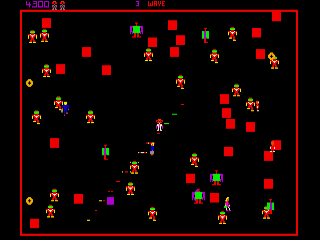
I don’t know what’s going on
Run around and shoot. If you manage to clear a stage of Grunts, Hulks, Sphereoids, Enforcers, Quarks, Tanks, and Brains then you warp to the next wave. Avoid enemies to survive, defeat enemies to progress, rescue humans for points. Lather, rinse, repeat.
Sinistar
- Developer: Williams Electronics
- Publisher: Williams Electronics
- Release Date: 1982
- Original Platform: Arcade
- Version Played: Williams Arcade’s Greatest Hits (Sega Genesis, 1996)
Beware, I live!
That’s the main attraction of this game. It can talk!
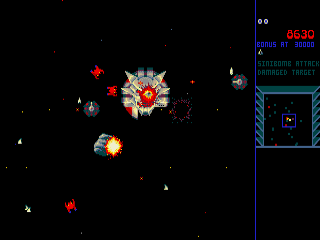
Not only was Sinistar the first game to utilize stereo sound but it also featured several voice clips! The map was spacious. There was a lot of frantic action going on. And it could all be tracked on your DeepSpace scanner. It was an impressive piece of gaming technology. A bit of a Western pinnacle… and then the industry crashed.
The game mixes together elements of various Western space themed shooters released at the time, primarily Atari’s Asteroids and Williams’ Defender, and then it ups the action several notches with a bit of strategy tossed in for good measure.
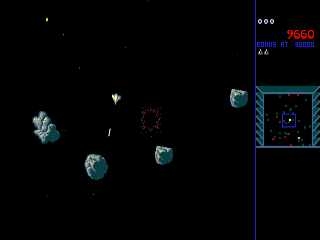
As the Siniship, you’re competing against worker drones of the planet Sporg to mine Sinisite crystals out of planetoids. You want them primarily to stop the drones from getting them first (and because your people require the crystals to power their civilization apparently). Should the drones dig up enough them, they’ll rebuild the sinister Sinistar!
The Sinistar is a massive destructive force – a living cosmic weapon. Sinistar will hunt you down and try to devour you. And taunt you with nifty digitized voice samples of American radio personality John Doremus. The Sinisite crystals you collect can be combined to build Sinibombs, which you’ll need several of to eradicate Sinistar.
Sini.
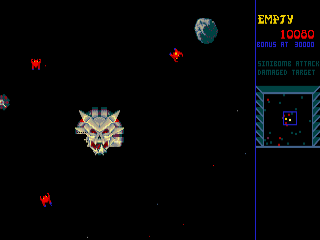
The information-filled HUD is impressive
You’ll bounce of enemies, but you don’t want to collide with what they’re shooting at you. Backing up the workers are Sporg warriors, which get increasingly more crafty and determined. If you survive the onslaught of enemies, you’ll move on to another sector of the galaxy where the miners are feverously working still to revive Sinistar again.
You have to be fast but not too fast. You want to mine the crystals out of a planetoid before the Sporg workers do, but if you’re too fast in shooting it, it will explode without leaving you any crystals to pick up.
The game has that Williams look that I’m not fond of, but you know what? It’s pretty impressive still with all the stuff that’s going on and you have to keep track of. The game has a good balance between action and strategy. And the technology is impressive. It’s not something I would actively want to sit down and play, but I can appreciate it for what it was and what it did for the industry… by moving it forward with yet another space shooting game.
Q*bert
- Developer: Gottlieb
- Publisher: Gottlieb
- Release Date: October, 1982
- Original Platform: Arcade
- Version Played: Game Boy Color, 2000
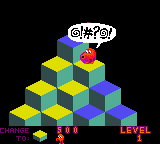
@!#?@!
We close out our look at 1982, by spotlighting Gottlieb’s classic action-puzzle game. Yes, Gottlieb – the pinball game manufacturer. They sure didn’t pick a good time to enter the video game industry what with the impending crash, but by outside of it they were able to bring to market this innovative and quirky game in an era of re-treads.
Programmer Warren Davis, artist Jeff Lee, and sound engineer David Theil must have done something right, since their little orange foul-mouthed creation is still fondly remembered today. He even made recent movie appearances in Disney’s Wreck-It Ralph and unfortunately Adam Sandler’s Pixels.
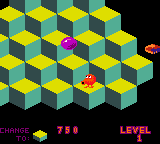
What makes the game particularly memorable and innovative is it’s psedu-3D isometric graphics, unique control scheme, and use of humour.
As Q*bert, I’m guessing some sort of deformed alien aardvark, you must hop about a M. C. Esher-like pyramid of cubes to change colours on all of its visible faces to a target colour while simultaneously avoiding obstacles and enemies along the way. The game is a very early and solid example of the platforming genre.
Standing in your way are ball that rain down upon you from the top of the screen, Coily the purple snake who’ll bounce about the stage, Wrong Way and Ugg will advance the pyramid starting from the lower corners, and Slick and Sam are some real jerks who will undo your cubiful colour changes. As would be expected, all of these obstacles have their own unique patterns they adhere to as they navigate the isometric pyramid. You can only attack Slick and Sam, because they’re green and Q*bert’s kryptonite appears to be anything of any colour other than green. For the other enemies, you have to dodge them and hope they eventually fall off thestage. At your disposal are green bouncing balls and spinning disks that will slow down enemy movement and briefly reset the pyramid of enemy presence respectively.
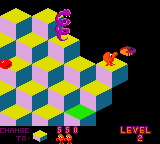
Combining the varying enemies and continually updating rules and conditions for blocks to bend to your colour-changing demands really elevates the game from a platformer to a puzzle game as the levels go on. It’s really a very nice balance and gets pretty challenging. You need practice and strategy. Amongst a sea of space shooters, the games vivid colours and appealing creature really made the game stand out from the crowd and draw in an audience. Addictive and charming, the game’s tagline was “Q*bert Qollects Quarters!”.
That’s not even the main catchphrase. Oh no. That would be @!#?@! – Q*bert’s penchant for rampant swearing. Through garbled, random, synthesized, unintelligible cursing, Q*bert perfectly identifies with the player in their moments of platforming frustration.
There’s also a couple intermission jingles like you would expect from a mascot game. But aside from that, and Q*bert’s potty mouth, the only audio is the constant and varied hopping sound effects of Q*bert and his obstacles. It all comes together in a sort of constant pulse tone that compliments the striking visual effect for the time.
Due to the isometric design of the game, Q*bert does not move horizontally or vertically – but rather, diagonally. Now, this can take some getting used to if not playing with an arcade joystick – such as myself using a standard D-pad. This messed with me far more than it should have. Oh well.
Bringing it altogether in a stroke of pinball flair, on the original arcade version of the game if and when Q*bert would fall off the pyramid, a physical and audible clunk would sound by a pinball table part smashing against the inner wall of the cabinet. Q*bert falls and clunks down by your feet. It’s unique and funny.
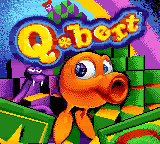
The version of the game I played was the Game Boy Color version by Majesco. I wish I had played a real arcade version with joystick play and clunky audio trickery. But this version of the game is special too. It’s a tale of devotion and fandom by one Paul Chinn. In the late 90’s there was a moderate Game Boy hobbyist homebrew scene. Paul ended up disassembling the original arcade game, wrote a perfect clone for the Game Boy Color, and released it on the Internet. About a year later, Paul heard from Majesco – the handheld rights holder at the time. Surprisingly, the didn’t come with a cease and desist, but rather a job opportunity. With Majesco’s support, an official port was developed by Paul for the Game Boy Color that also included a new Adventure mode with some other new additions. Pretty neat.
Q*bert was the only successful game to come out of Gottlieb (most of which were released in the midst of the aforementioned crash), which is a real shame. Following the likes of Pac-Man, Donkey Kong, and Frogger, Q*bert was another fantastically marketable character – but this time not from Japan! Lunch boxes, toys, a television show, and merchandise galore.
The popularity and success of this game, its unique premise and gameplay, its quirky cast of characters, its use of humour and hardware effects demonstrates how diseased the North American video game developers were at the time.
Because, they didn’t make this game.
Atari and Williams didn’t make Q*bert. A damn pinball manufacturer did, and that foretells everything about how Japan would go on to resurrect the video game industry following the crash. Games not developed by the old industry but by toy manufacturers and pachinko machine builders. Developers not tied down to the old ways of doing things. People not afraid of trying new things and reinventing old things. Characters with personality and charm.
Stagnation and contentment are a dangerous thing.

Retro Rewind: 1981
