







The Legend of Zelda: A Link Between Worlds
3DS
Nintendo EAD
Nintendo
Action Adventure
Everyone
November 22, 2013 (NA, EU)
November 23, 2013 (AU)
December 26, 2013 (JP)
At first glance, A Link Between Worlds looks like a desperate attempt to cash in on gamers’ nostalgia for the SNES classic A Link to the Past, and it definitely does play on nostalgia more often than not. However, Nintendo ironically used such a nostalgia trip to experiment with some pretty ambitious tweaks to the Zelda formula. Some of these experiments prove successful, some not so much, but it’s good to see them trying to push aside some of the series’ tropes, and in the end A Link Between Worlds is a decent – if slightly forgettable – romp through a familiar world.
Huge disclaimer right from the start: I have no great nostalgia for A Link to the Past. My first experience playing that game was actually on the GBA, after I had already played several other entries in the series, so I didn’t get to experience the SNES classic during my formative years. I found that the game, while still great, had been eclipsed by more recent entries in the series such as Ocarina of Time and, perhaps more appropriately, The Minish Cap. So I went into A Link Between Worlds without the lofty expectations that nostalgia can bring.
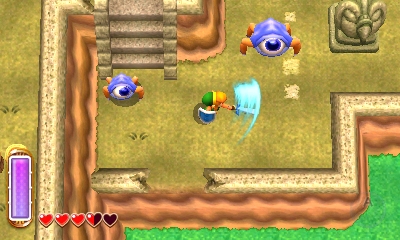
The overworld will feel instantly familiar to anyone who’s played A Link to the Past.
The first thing you’ll notice is that A Link Between Worlds takes place in the same world as A Link to the Past – and by that, I mean everything in the overworld is practically identical, right down to the location and size of the trees. Some might call that a throwback, others might call it laziness on Nintendo’s part, but whatever you call it, it’s going to feel overly familiar to people who have played the classic game. Even the Dark World returns – this time as a separate kingdom called Lorule that is accessed through dimensional cracks located throughout Hyrule – but all it takes is one look to know that it’s the same Dark World from the previous game.
What keeps this version of Hyrule interesting enough to return to, however, is the new wall-merging mechanic introduced as the main gimmick in A Link Between Worlds. After obtaining this power early in the game, Link can walk up to literally any unobstructed wall in the world and merge into it, taking the form of an Egyptian-styled painting. It’s an absolutely integral part of the game from start to finish, and if you see a treasure that seems out of reach, or a puzzle that’s unsolvable, often the solution will involve merging into the walls. You can also use it to evade damage, giving you a way out if you get backed into a corner by enemies. It’s the best part about the whole game, and the care and testing it must have taken to make it work throughout the entire world, and to do so fluidly, is commendable.

The wall-merging mechanic is seamlessly integrated into the game world, allowing you to creatively access places which are otherwise unreachable.
The biggest departure from series conventions, however, comes in the way that items are obtained. Gone are the days of “enter dungeon, find item, use item to beat the dungeon”; instead, items are now available to be rented from a friendly guy in a rabbit costume named Ravio. Early in the game he takes up residence in your house, and from that point on you can rent as many items as you need from him for a low price. The rental period lasts until you die, after which his pet bird will collect any items you’ve rented and you’ll have to rent them again. There is no set number of items that you can carry thanks to a new stamina bar which controls item usage and wall-merging time. As long as you have stamina left in your meter, you can use items or merge into walls, and if you wait a few seconds the meter recharges fairly rapidly. It’s very convenient in that it practically eliminates inventory management entirely and you never have to worry about having enough bombs to complete a dungeon, but at the same time it’s fairly unrealistic and oversimplifies things a bit.
For considerably more money, you can alternatively buy the items, after which the items are yours even if you die. Buying items allows you to upgrade them by finding lost creatures called Maiamais that are scattered throughout the world and returning them to their mother, who will upgrade one item for every ten of her children you return to her. Having to keep renting items can be an expensive proposition if you die a lot, and purchasing them is even more so thanks to Ravio’s extortionate prices for item purchases. Thankfully there’s no shortage of Rupees in A Link Between Worlds, and I found myself having all the items bought by about halfway through the game.
Despite having all the items available to you from the get-go, however, the game isn’t devoid of exploration. On the contrary, there are plenty of nooks and crannies to uncover, which might lead to treasure chests, heart pieces, or even mini-dungeons. There are also 100 of the aforementioned Maiamais that are scattered all throughout the world, and even though you have a convenient chart that tells you how many are left in each particular region of the map, and you can hear them chirping when one is nearby, it can still take some creative thinking to find their exact location.

Items are now obtained almost exclusively through Ravio’s shop.
The bigger boon to exploration is that, because you can now obtain what would normally be dungeon items in any order, and could theoretically have a full set early in the game, Nintendo has made another fairly significant departure from recent Zelda titles by allowing you to complete the dungeons in any order. Being able to choose which dungeon you do next is a step forward in making the series less linear and hand-holding, and the item that you’ll need to complete the dungeon is displayed prominently at the entrance. At the same time it destroys any semblance of a difficulty curve, since no dungeon can be significantly tougher than another. That said, a few of the dungeons do offer a decent challenge – the Ice Ruins in particular – and don’t be surprised if you find yourself looking for hearts, especially early on. Later, once you’ve upgraded your weapons and received some other equipment to help reduce damage to you and increase your damage output, the tables are turned and the game can become almost too easy -although you should still expect some refreshing difficulty spikes to come out of left field to kick you in your ass.
The bigger issue with the dungeons, however, is that they’re flat-out boring – with a few exceptions. In more recent Zelda games, each dungeon has its own unique setting, personality, and “feel,” such as Twilight Princess‘ Snowpeak Ruins, The Minish Cap’s Palace of Winds, or Skyward Sword’s Sandship and Ancient Cistern. Those dungeons, among many others, are memorable, whether because of a unique setting, intriguing puzzles, or interesting subplots. A Link Between Worlds, however, regresses to the A Link to the Past style of dungeon design, where dungeons are basically made up of same-color tiles, using the same generic puzzles and a dull, uninspired art style. There are a few exceptions, such as one dungeon that plays with the concept of light and dark, and the aforementioned Ice Ruins, but often the only way to differentiate dungeons in A Link Between Worlds is by what color and style the tiles are.
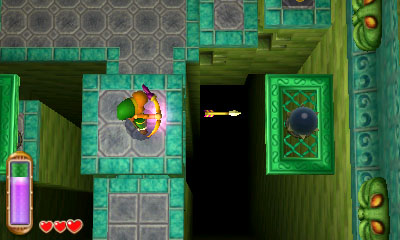
This is a typical dungeon in A Link Between Worlds. Except this one is green and gray.
The drabness of the art style in the dungeons translates to the game as a whole. While many Zelda games have each taken on their own unique graphical style that is appropriate to the tone of the particular entry in the series and adds to its character, A Link Between Worlds has a graphical style that can best be described as bland and generic. It’s basically A Link to the Past remade in semi-3D graphics, and while that game was – and still is – a gorgeous testament to 2D game design, it doesn’t translate so well into 3D. There is no real identifying characteristic here, and while the game isn’t ugly, it is fairly bland. Link, too, is back to being a personality-less enigma, which is a disappointment after games such as The Wind Waker and Skyward Sword added so much to their respective Link’s characterization – despite never saying a word, those games did a fantastic job of giving his character a personality through facial expressions and actions. He’s also not as athletic or as skilled in swordplay as some of his predecessors – other than the trademark Spin Attack, gone are the special moves and even the rolling ability from previous (even 2D) entries in the series, and Link is relegated to only basic press-B-to-slash swordplay.
On a technical level though, the graphics shine. A Link Between Worlds is the first Zelda game to run at a brisk 60 frames per second, and it shows. Animations are incredibly smooth, and the game runs at a noticeably faster pace than other entries in the series. The 3D effect is also one of the best on the 3DS, and a few of the dungeons even make great use of that effect. This is one game where you’ll want to keep the 3D slider on.

Oh yeah, and this guy is back.
The soundtrack is also phenomenal, with lots of orchestrated remixes of familiar A Link to the Past tunes combined with newly-composed tracks. Like the rest of the game, there are a lot of throwbacks to its predecessor that will elicit a grin from anyone who has any attachment to that game. A lot of care went into the sound design for the game, and as a result the soundtrack in A Link Between Worlds stands right up there with Skyward Sword as some of the best music the series has to offer.
The game is fairly short – you can probably breeze straight through the game in 10 hours or so, but exploring and collecting all the hidden Maiamais and treasures will add several more hours. After you beat the game once you’ll unlock Hero Mode, in which enemies have slightly improved AI and do a metric crapton more damage. There are also a few bonus scenes that are only shown in Hero Mode, but nothing overly significant to the plot. Still, the game has some difficult moments as it is, so Hero Mode is definitely worth a replay for Zelda veterans looking for a challenge.

Somehow I think that’s about to change…
Overall, the best word I can use to describe A Link Between Worlds is forgettable. It’s a fine game, and there’s nothing really bad about it, but at the same time there’s nothing particularly memorable or notable about it either. While it’s great to revisit the world of A Link to the Past, the constant throwbacks to its predecessor, and the fact that the world is basically identical and hasn’t changed a bit in hundreds of years, make the game at times feel more like an enhanced remake than a sequel. The game really doesn’t take on a character or a life of its own and is content to just rest on its predecessor’s memory, and as a result it’s lacking in the usual charm and, for lack of a better word, “soul” we’ve come to expect of the Zelda series. As Nintendo has done with the Mario series, they’ve created what amounts to New Legend of Zelda here.
But even though they’ve had mixed results, the steps that Nintendo has taken to break out of series conventions in this game are admirable, and I’m excited to see how they fine tune things and push the boundaries a bit more in the Wii U Zelda game that we should be seeing at E3 in just a few days. It’s nice to not be treated like a brain-dead toddler and be hit over the head with tutorials all the time, and the freedom to explore is a welcome return to the series’ roots. Overall, A Link Between Worlds is a decent nostalgia trip and retro throwback, but I can’t wait to see Nintendo try new things and push the boundaries of Zelda in a game where they’re not confined to an already-existing world.
Pushes the boundaries and challenges series conventions, while at the same time returning to the series' roots and encouraging exploration.
Lack of excessive hand-holding.
Creative wall-merging mechanic.
Fantastic soundtrack and use of 3D.
Good retro-style throwback.
Feels overly familiar with lots of recycled content.
Bland graphical style and uninspired dungeon design.
Item rental system and being able to do the dungeons in any order affects progression and difficulty curve.
Link's characterization and combat ability are a step backwards.

The New Galio: Rework or Replacement?

Assassin’s Creed 2017: A History of Leaks and Rumors

Combat is such a step backwards. The Minish Cap had attacks you could learn, like in Twilight Princess (although TMC did it first), and here you don’t. Just standard top-down slashing. Above all, this made it feel like “New Legend of Zelda” to me because that’s what Nintendo’s done in NSMB – ignore game play mechanics from SMB3 or World or even try to advance them further, and just ground it to the first SMB on the NES. I don’t understand it.
I disagree on the dungeons though. They may be bland, but that’s how they were in the era of LoZ and ALttP. And true to ALttP (and let’s say The Wind Waker too), they were big vertical dungeons. Scope was okay, they were easy though.
Even if they wanted a ALttP retro feeling here, I can’t understand why they had to go with thisvisual look or copy the overworld nearly exactly. Four Swords Adventures handled both aspects far better.
Maiamais, best part of the game