










Resident Evil HD Remaster
PlayStation 3
PlayStation 4
Xbox 360
Xbox One
PC
Capcom
Capcom
Survival Horror
Mature
November 27, 2014 (JP)
January 20, 2015 (Worldwide)
While available for several platforms, this review is based on the Xbox One and PC versions of the game.
When Capcom remade its classic survival horror title Resident Evil for Nintendo GameCube in 2002, the series seemed to be at the top of its game, even when the slightly more action-focused Resident Evil 4 was released two years later. After the games’ releases though, Capcom continued taking the series further away from its origins and turned it into an action series that, while certainly not bad, can hardly be considered Resident Evil after a point. Recently however, Capcom has shown an interest in appealing to both aspects of the series, namely following the success of the slightly more survival horror-focused Resident Evil: Revelations. This brings us to an updated release of 2002’s remake of Resident Evil, released in 2014 in Japan. Does the game still hold up today, or is the series’ origin better left in the past?
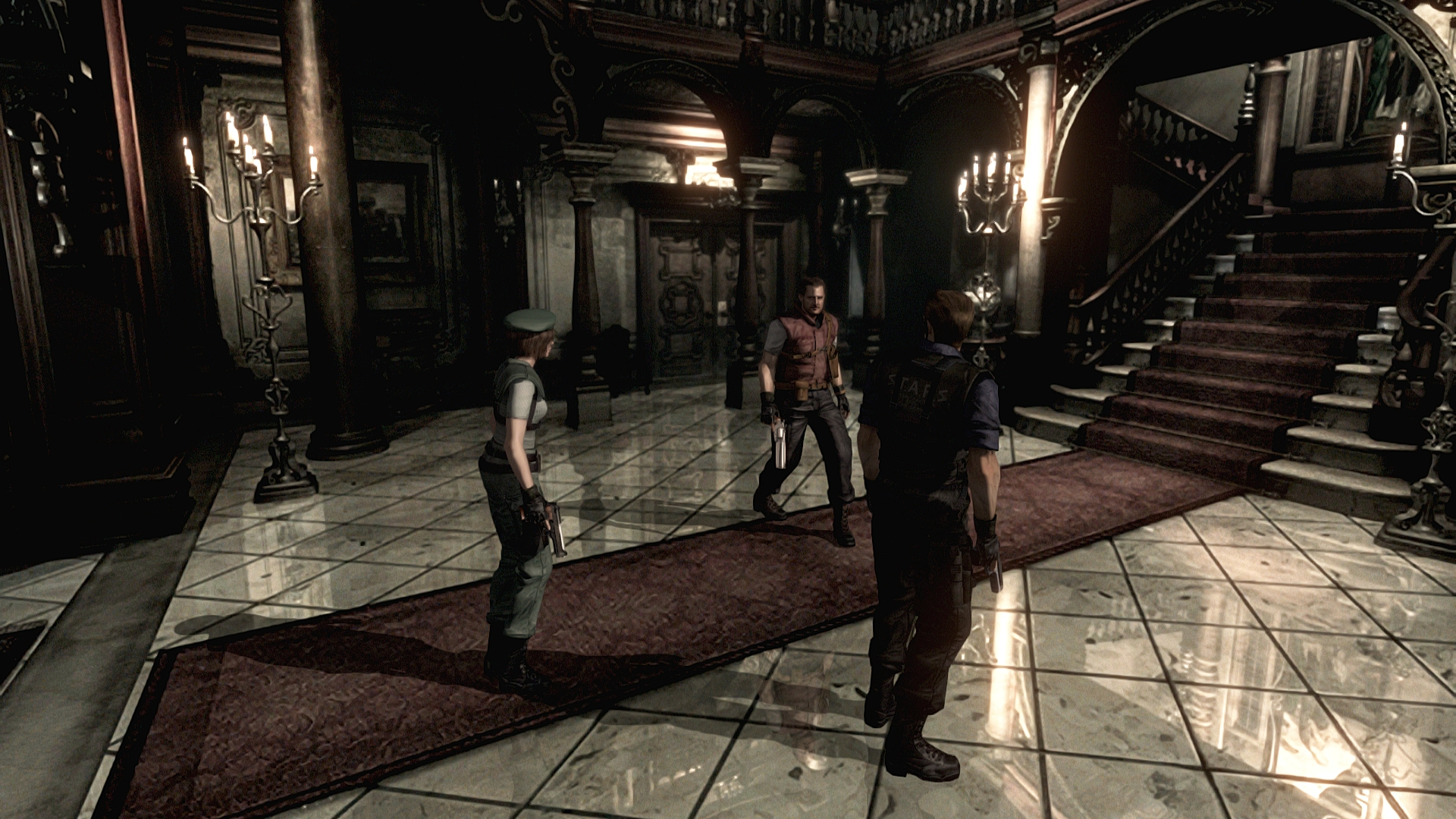
In Jill’s story, she, Barry, and Wesker become separated from Chris and Brad.
The story begins in July 1998, when Raccoon City’s S.T.A.R.S. Alpha team (Consisting of Chris Redfield, Jill Valentine, Barry Burton, Albert Wesker, and Brad Vickers) is dispatched to the nearby forests of the Arklay Mountains in search of the missing Bravo team, who themselves had been investigating recent cannibalistic murders in the mountains. After the team discovers Bravo’s wrecked helicopter and is attacked by mutant dogs, they rush for safety to a seemingly abandoned mansion. In the process however, some of the team goes missing, and the remaining members split up to discover the secrets of the mansion, and the truth behind the murders.
This is where the story splits off. At the start of the game, you’re given the option of playing one of two characters: Chris Redfield, or Jill Valentine. While both sides of the story follow the same overall route through the world, each character has different stories that feature different characters– Jill is assisted by Barry Burton throughout the game, while Chris attempts to survive with the help of Bravo member Rebecca Chambers. The differences continue during gameplay, however; Jill’s game is meant to appeal to newcomers to the series, offering additional inventory slots and additional assistance from Barry, while Chris has fewer inventory slots and doesn’t receive as much help from Rebecca.

Resident Evil makes use of predetermined camera angles to help create tension.
Thankfully, regardless of who you choose to play as, the game is an absolute blast. The game is played from a third-person perspective, but rather than being over-the-shoulder like in later Resident Evil titles, it makes use of pre-rendered backgrounds with set camera angles. While this can make it slightly annoying when the camera shifts to a completely different viewpoint, it helps create a lot of tension– for example, a room may have the camera deliberately set at a specific angle so you can’t see around a corner, making you wonder if there’s anything about to attack you, or if there’s even anything there. As you explore the mansion and its connected areas, you’ll come across puzzles that may need a later-game item to be solved, or you may come across items that may not solve any puzzles until several hours later. In fact, you may come across items that will seem useless upon first inspection, but will become essential the more you look into them. The way the game handles puzzles encourages exploration, which creates a clash in your mind: the room may have zombies or dogs or something worse around the corner that can easily kill me, but at the same time, what if there’s something past them that I need or can use? The game makes you weigh risks and rewards, which helps create the aforementioned tension that has become celebrated over the years.
While the pre-set camera angles may annoy some, the new release of the game does offer a new control scheme that may make the game more approachable. By default, the game is set to these controls, which let players move in whichever direction the left analog stick (or WASD keys, if that’s your thing) is being pushed towards. However, these controls can sometimes “break” the game by making enemy encounters easier to bypass– for those who prefer the older”tank” controls, Capcom has included a classic control option where moving forward always requires pressing up.

Some of the game’s darker backgrounds fall victim to “crushed blacks” that make it harder to see certain parts of the screen.
In addition to the new controls, Capcom has updated and changed other aspects of the game as well. While the game can be played at the original 4:3 aspect ratio, there is also an option for a full widescreen 16:9 ratio. As this can cut off parts of the screen when enabled, the game “scrolls” the camera up and down or left and right as Chris or Jill moves across the screen. Regardless of which option is chosen, the game uses updated backgrounds that, while mostly unchanged, may feature new lighting or animations. One downside to this is that in the transition from GameCube to modern platforms, some of the darker environments have fallen victim to “crushed blacks,” where dark parts of the screen may blur together and become harder to distinguish. Thankfully, these instances are largely unnoticeable, and rarely affected my enjoyment of the game.
While the controls and backgrounds may have been altered in some ways, the game’s overall visuals and sound haven’t. Even though many backgrounds look the same as they did more than ten years ago, the game still looks great in motion, with the Spencer mansion still one of the most interesting and creepy locales the Resident Evil series has seen. Of course, as you explore the estate, the various areas are accompanied by different kinds of sounds. A forested area may have nothing but the sounds of moving leaves, distant thunderstorms, and crows, while a room may be eerily silent, possibly hinting at a sudden enemy encounter. While the background sounds and ambiance are mostly fitting for their respective areas, the game suffers from a problem shared by many games released over a decade ago: relatively poor voice acting. While the remake’s voices are infinitely better than those seen in the original 1996 game, meaning there are no Jill sandwiches, they still leave much to be desired, with some performances falling flat. Thankfully, this doesn’t detract too much from enjoying the story, but it’s definitely worth noting, as it’s one particular aspect that later Resident Evil titles definitely improved on.
All in all, the remaster of the Resident Evil remake is the definitive way to experience one of gaming’s more classic titles. Even with the still-lackluster voice acting, exploring the Spencer estate and uncovering its horrific secrets is one of the most immersive experiences offered in a game thanks to the game’s art direction and gameplay. If you’re a fan of horror games, newer Resident Evil titles, or even if you just want to relive the horror, the new release of the game is absolutely worth picking up.
The thirteen-year-old game still proves to be effective in immersion, thanks to its strong visuals, haunting music, and challenging gameplay. The new release offers new settings for viewing and playing the game, making it more accessible than ever before.
Some backgrounds in the new release have mixed blacks that make it more difficult to distinguish certain parts. Characters' voices feel just as flat as they did in 2002, though thankfully they're still tolerable.

The New Galio: Rework or Replacement?

Assassin’s Creed 2017: A History of Leaks and Rumors
