








The Last Story
Wii
Mistwalker
XSEED Games
RPG
Teen
January 27, 2011 (JP)
February 23, 2012 (AU)
February 24, 2012 (EU)
August 14, 2012 (NA)
The Japanese RPG genre has come under increasing criticism for being stuck in the past, being known for its stubborn reliance on clichéd plots and characters, molasses-slow pacing, and usually methodical, turn-based combat. The Last Story seeks to change all of that, defying JRPG conventions and providing a breath of fresh air for a genre that really needs one.
Created by Hironobu Sakaguchi, father of the Final Fantasy series and one of the masterminds behind Chrono Trigger, The Last Story has to live up to a lot of high expectations. Sakaguchi’s studio, Mistwalker, brought the Japanese RPG to current-gen consoles with the uber-traditional Blue Dragon, which was widely received as a decent but generic JRPG. The studio followed up with the excellent Lost Odyssey, which was more Final Fantasy than recent games in that series, and one of the best JRPGs of this generation. With such a pedigree, it’s easy to see why gamers were outraged when Nintendo of America declined to localize the game despite its European release, but thanks to XSEED stepping up to the plate, North American gamers can experience the Wii’s last story.
The game follows Zael, a mercenary with a big sword, and his journey through a world that’s part-fantasy, part-futuristic/steampunk. When the monstrous Gurak army approaches (whose leader is almost the spitting image of Twilight Princess’ Ganondorf), Zael and his mercenary band are thrust into the middle of the conflict. Along the way he’ll battle vicious monsters, face betrayal and corruption at every turn, harness a supernatural power, and, of course, fall in love.
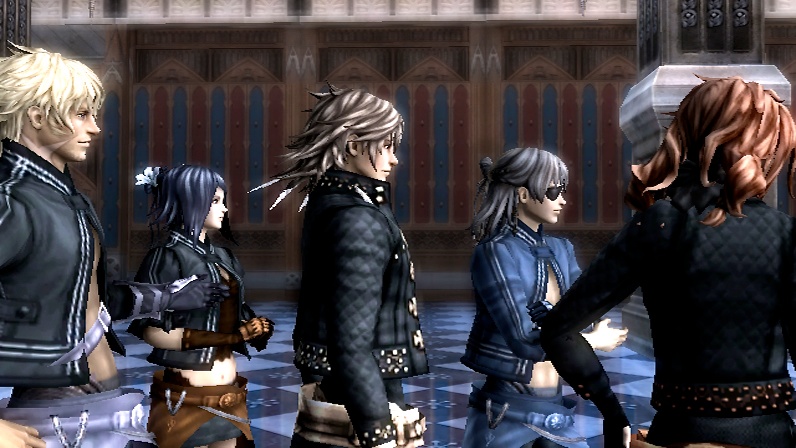
The main party is a lively bunch of fleshed-out, interesting characters.
If you’re thinking that sounds like a cookie-cutter JRPG plot, you’re pretty much right. Thankfully, the characters more than make up for the generic plot. From Lowell, the token womanizer and comic relief of the party, to Syrenne, a zealous alcoholic tomboy, each character is memorable and will leave an impression on you long after you beat the game. Many of the characters receive appropriate development as the game goes on – for example, Yurick, the distant, brooding mage, eventually faces his past, learns to open up and trust his fellow mercenaries, and eventually becomes a central, inseparable part of the group.
It’s the evolution beyond genre tropes that makes the characters in The Last Story so great. Though many of them begin as JRPG clichés personified, they eventually develop into fleshed-out characters with deep personalities and backstories. None of them are one-dimensional, unbelievable characters – by the end of the game, you’ll relate to and become attached to every member of your party.
You would think with so much character development and backstory, the game would drag on for hours on end, but that’s not the case. The Last Story clocks in at 20-25 hours – a decent length for a normal game, but incredibly short for a JRPG. By the 10 hour mark in most JRPGs, you will have barely left the starting town; in The Last Story, you’ve already been treated to action, character development, and events which serve as catalysts that will bring about the final confrontation. It’s incredibly streamlined and avoids the godawful pacing that plagues the vast majority of RPGs.
But then again, it plays less like a JRPG and more like an action-adventure game. Sure, you have your inventory management, upgrade system, stat boosts, experience points, and all the other RPG standards. But there’s no vast open world to explore: the game’s central hub, Lazulis City, serves as your base of operations for the entire game, and every few chapters you’ll head off to a cave, fortress, or other dungeon-like area to dispatch enemies on a fairly linear path. Puzzles are practically non-existent, and there’s really no room to explore in these dungeon areas.
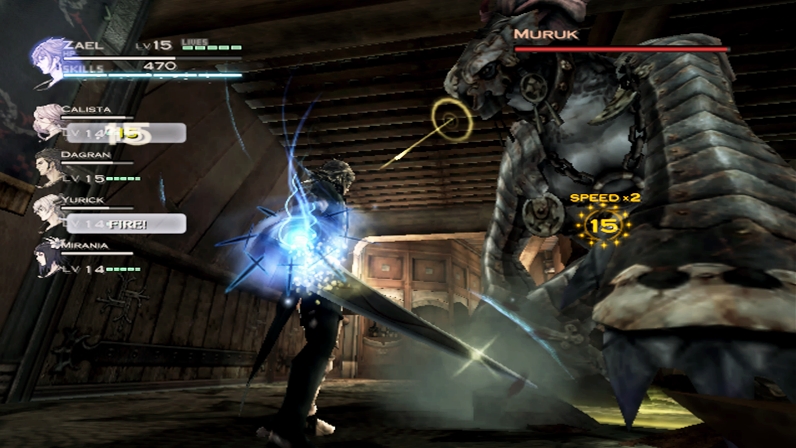
The combat system is fun and engaging, especially when fighting big bosses like this guy.
In addition to all of that, The Last Story eschews turn-based combat for a real-time system that combines outright whacking things with swords with stealth and strategy. Some battles boil down to simply breaking an enemy’s guard and beating them down until their HP runs out (make sure you change the combat from Auto to Manual as soon as you start the game – it’s much more fun that way), but a good number of them also require you to plan your attack. Many enemies will call reinforcements if you just run in and start attacking, so you’ll have to draw their attention away (by hitting them with an arrow from Zael’s crossbow while hiding) and get them alone before dispensing them individually. These battles are the best in the game, because they require you to think and carefully plan your approach to each battle.
Another element to the battle system comes in the form of magical attacks, which leave residual circles on the ground. These circles damage enemies, but can also be diffused by Zael’s Gale attack to create a variety of effects. Fire circles cause enemies to break their guard when diffused, ice circles cause them to slip and fall, heal circles restore health to your entire party, and so on. Many enemies require a specific strategy to defeat, so, for example, if an enemy is spamming magic attacks from a distance, you’ll need to order Mirania to use a Nature spell and diffuse it to silence their magic. In some battles, you can also order your allies to take out pillars, ceilings, or other conveniently-placed objects, effectively turning the environment against your enemies.
I mentioned a supernatural power earlier. Early in the game, Zael acquires the ability to harness said supernatural power (called Gathering), and it becomes indispensable in battles. At any time, with a press of the L button, Zael can draw enemies toward him and away from his party members. This allows for your mages to attack without fear of being interrupted during their casting period, or for low-health party members to run to a heal circle. Later in the game, each attack Zael receives while in this mode adds to a burst gauge, which, when full, will allow him to stop enemies in their tracks when activated.

Diffusing residual circles left by spells adds an amount of depth and strategy to the real-time combat.
In addition, while Gathering is activated, Zael can simply run up to a downed party member and revive them. Each character has five lives, which are replenished after every battle – so while losing lives is common, it’s very rare to see a game over screen except in the hardest of boss battles. It’s incredibly easy to level in the game – after almost every battle at least one or two of your party members will gain a level, and it’s a refreshing change of pace to not have to grind endlessly to beat a tough boss. If you do get stuck on a boss, however, you’re not trapped. Placed liberally throughout the game are summon circles, which will instantly spawn a group of enemies for you to defeat. These circles can be used an endless number of times and are usually placed conveniently next to save points and right before boss battles.
The game also introduces a Gears of War style cover system. Throughout each battlefield you’ll find various debris or walls everywhere. Characters can hide behind these when faced with enemy attacks, and Zael can spring from his hiding place and unleash a devastating slash attack that will do heavy damage or even KO enemies. Everything combined adds up to an incredibly deep, engaging battle system – and that’s not even mentioning the little things, such as countering attacks or deflecting magic by guarding against them at the right time, or Spirit attacks which basically serve as the game’s limit breaks. The combat system in The Last Story obviously has taken a lot of lessons from Western game design, and it’s a huge breath of fresh air for a JRPG.
The Last Story also has a number of sidequests, from the mundane (such as getting items for a merchant) to entire optional chapters with their own plot (that often ties into the main plot and develops the characters even more). It’s rare to see such thought put into sidequests, and even the most trivial ones have rewards – usually a rare item that you can use for upgrading your weapons or armor – and many of the quest givers can be revisited as the game goes on with another plight requiring your help. In addition, the game not one, but two online modes – a claim very few JRPGs can make. There’s a competitive Versus mode, where players join together and try to kill the other team, and a cooperative mode where players form a team and take out seven main story bosses. Items, weapons, and armor you win online transfer into the single-player game. It’s not much, and don’t expect to be enthralled by it, but it’s there.

There are a ton of customization options, and every weapon and piece of armor has its own unique appearance.
Graphically, the game looks incredible for a Wii game. It lacks the massive, lush, colorful environments of Xenoblade, but has much better character models and textures, and a lot of detail in general. Every weapon and piece of armor looks different when equipped, and as they are upgraded, their design is upgraded appropriately as well. Not only that, but you can also customize the color of nearly every aspect of your character’s clothing.
Facial animations are great, and Lazulis City comes alive with the children running in the streets between the tightly-packed buildings, knights and nobles standing about, and people going about their daily lives. It’s a sizeable city with a lot to do and lots of little nooks and crannies to explore, and, with a few exceptions, it loads seamlessly. The floor in Lazulis Castle sparkles and gleams, with reflections of the surroundings and characters, and some of the late-game areas have the same polished, reflective effect, which looks downright beautiful. Most of the dungeons, on the other hand, are fairly linear corridor-like affairs, mostly in shades of brown, green, and gray, and menu design is bland and fairly unattractive.
Unfortunately, the developers pushed the Wii hardware too much at times, and the framerate sputters and coughs at regular intervals. While most of the time, the framerate drops aren’t enough to affect gameplay, the game crawls at a snail’s pace during some big battles when the typical JRPG pyrotechnics are going on. A few boss fights especially suffer because of it – there’s one late-game boss in particular that’s incredibly cheap to begin with, with a practically-OHKO attack that you have to guard counter with fairly precise timing in order to keep your entire party from being silenced and taking huge damage. That becomes a near-impossible task when the game is jerking around and not responding immediately to your input. Thankfully, it’s usually not that bad, but it’s a shame the Wii struggles so much at such inopportune times.
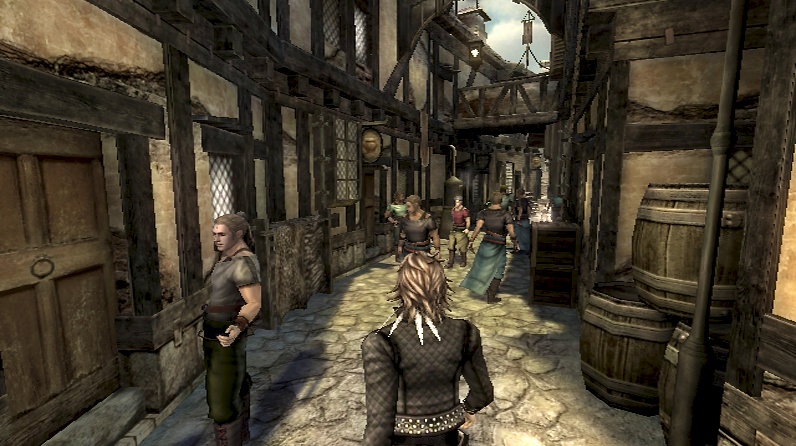
Lazulis City is a bustling place, full of nooks and crannies to explore.
I can’t finish the review without mentioning the game’s soundtrack. Scored by famed Final Fantasy composer Nobuo Uematsu, The Last Story features one of the best soundtracks on Wii. From the game’s gorgeous main theme to the battle themes and the soaring melodies that accompany key scenes, the score never ceases to amaze, right up to the final boss theme, which is an incredibly cheesy heavy metal theme that’s as deliciously overboard as the theme Uematsu created for Lost Odyssey‘s final boss. XSEED kept the British voice acting from the European release of the game, and while it may take some adjustment for American ears, I can’t imagine the game being any other way. Every character’s voice is a perfect fit, and it’s clear the localization team went out of their way to capture each character’s personality in their voice. I’d never be able to imagine Syrenne without her Cockney (correct me if I’m wrong – I never claimed to be an expert on British accents!), low-brow, drunken shenanigans, or Lowell’s suave Scottish flirtations.
The Last Story is an absolutely phenomenal game and serves as a beautiful swan song for the Wii, as well as an incredible final JRPG for this generation of consoles. It’s not without problems – namely the sometimes-crippling framerate – but it’s a unique blend of traditional Japanese RPG elements and Western game design. It’s paced incredibly well, cutting out the fluff and streamlining the RPG experience, while providing superb gameplay and a lovable cast of characters. Even if you’re not usually a JRPG fan, The Last Story is fresh and different enough to make it a must-play experience. Let’s hope JRPG developers take notes from this game and continue to advance the genre beyond the stagnation of the past few years.
Streamlined design with near-perfect pacing.
Likable cast of developed characters with fleshed-out backstories.
Surprisingly deep, engrossing combat system.
Lots of customization options.
Technically impressive graphics for the Wii.
Incredible soundtrack by veteran composer Nobuo Uematsu.
Charming British voice acting that fits each character perfectly.
Blend of standard JRPG elements with Western game design provides a breath of fresh air for the genre.
Horrible framerate issues at inopportune times.
Bland dungeon design.
A couple cheap boss fights compounded by bad framerate.
Fairly generic plot.

The New Galio: Rework or Replacement?

Assassin’s Creed 2017: A History of Leaks and Rumors
