








Galaga
- Developer: Namco
- Publisher: Namco / Midway
- Release Date: December 1981
- Original Platform: Arcade
- Version Played: “Galaga: Demons of Death” (NES, 1988)
You might also recall that I really enjoyed playing Namco’s shoot ’em up about invading mutant space insects of doom, “Galaxian”. Galaga is a marked improvement over its predecessor. It retains the core of Galaxian, while being just different enough to feel fresh (and not samey, unlike Stargate).
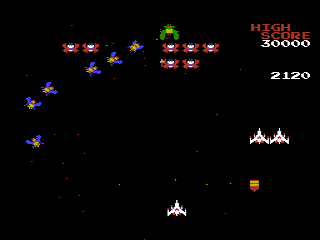
It is more chaotic but no less fun. Building on the formula established by its predecessor, Galaga introduces several new concepts to the fixed vertical shoot ’em up genre that made it a big arcade hit. There are new audio and graphical effects, enemies can transform, and there are bonus Challenging Stages.
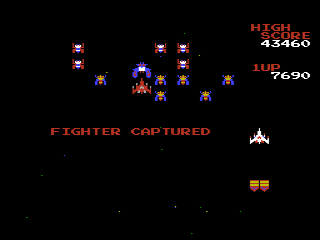
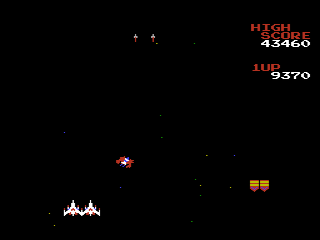
The most notable new feature is the opportunity to increase your firepower. Occasionally, Boss Galagas will hover in midair and emit a tractor beam to try to capture your starfighter – the Gyaraga. If you’re so inclined, you could intentionally allow the your fighter to be captured. Doing so enables you to rescue it when playing as your next available fighter and have it return to fight by your side! Multiple Gyaragas and side-by-side firepower! This is especially rewarding, as the famous spaceship is known to be the “most alluring, captivating, and enchanting thing in the universe”. ;P
While this grants you an increase in power, it also increases your size making you more vulnerable and susceptible to enemy fire. So, plan accordingly. I really like the concept though, that in the middle of an ever-increasing hectic space fire fight, you can strategically plot to sacrifice yourself for the opportunity of a potential advantage.
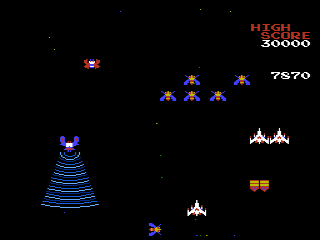
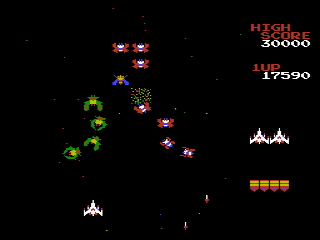
Simple, addictive, and fun.
Loco-Motion
- Developer: Konami
- Publisher: Centuri / Konami
- Release Date: ~1981
- Original Platform: Arcade
- Version Played: “Konami GB Collection – Vol. 3” (GBC, 2000)
- Also known as “Guttang Gottong”
I don’t have much to say about this. I suck at this game, so I didn’t see much of it at all. This is a sliding block puzzle game. Move pieces of a railroad track around so that a constantly moving locomotive can complete its journey. Ordinarily I would be completely fine with this. I like these kinds of puzzles in the Professor Layton series, for example. But, the damn train starts moving immediately, which really complicates matters. There are apparently passengers to pick up, but my train often crashes so early that these people are left stranded.
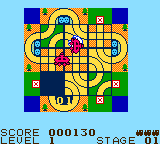
honestly, this is as far as I got
If passengers wait too long, a “Crazy Train” is added to the track and will try to crash into your not crazy but just annoyingly impatient train. Crashing multiple Crazy Trains together can cause aftermath effects like a dead-end on the track or taking out a passenger-filled station in the process.
Ms. Pac-Man
- Developer: Namco
- Publisher: Namco / Midway
- Release Date: ~1981
- Original Platform: Arcade
- Version Played: NES (Tengen), 1990
I really like the history around this game.
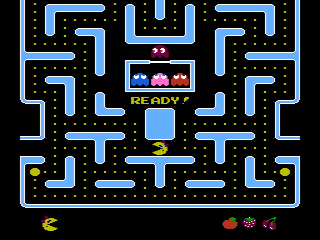
Ms. Pac-Man began as an unauthorized enhancement kit for the original Pac-Man arcade game by Namco. The General Computer Corporation sold their mod-kit, dubbed “Crazy Otto”, to Midway – the American distributor the Pac-Man games. Now, Midway was growing impatient with Namco’s delay in producing a sequel to the smash hit. They filled the gap as they waited for Namco’s “Super Pac-Man” with GCC’s mod-kit.
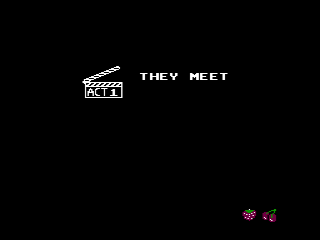
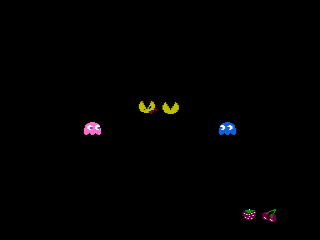
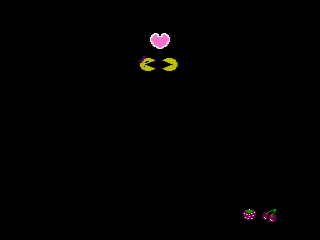
“Crazy Otto” starred “Waka-Man”, later “Otto-Man”, who was essentially a weird-looking Pac-Man knock off character with big blue eyes and long legs. The ghosts were now little puff-ball monsters with feet and antennae. Aside from the superficial, there gameplay additions as well – there were now multiple mazes! There was also some extra randomness to the game when compared against the original Pac-Man, you couldn’t rely on patterns as much. The cutscene intermissions were also new. It’s Pac-Man with a series of patches applied to optimize the experience.
After Midway got involved, Otto-Man became Pac-Man once again and the familiar ghosts were restored. Midway, citing the large number of female players (or “lady arcaders” as it was termed) of the original Pac-Man, decided the main character should be a woman. And so “Pac-Woman” was born. As you might as guessed, this character eventually became the familiar “Ms. Pac-Man” we know and love. In this transition though, the animation lost the 3D effect of Otto where you could see a front and back view of the character. Which, I think is unfortunate.
The game was a success and Namco was impressed. So much so that the game ultimately became part of the canon Pac-Man catalog (unlike other Pac-Man games Midway put out in the same fashion).
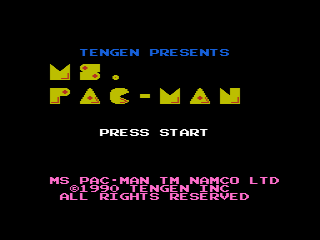
Okay, so we now have Ms. Pac-Man and it’s better than Pac-Man in every way. How do make a game that started out as an unauthorized enhancement even better? Well, you make an unauthorized enhancement of that too of course. Enter Tengen!
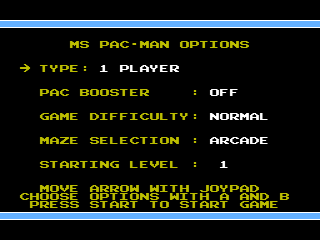
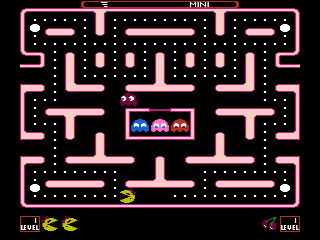
It should be noted that Namco eventually brought an official port Ms. Pac-Man to the NES in 1993. It paled in comparison to what Tengen produced a few years earlier. Namco’s version was a similar barebones port like Pac-Man before it (covered here previously). More than an arcade port, Tengen’s version improves the improvement. They added new modes and content, additional maps, difficulty levels, and optional game modifiers. There are multiple board sizes and types. Some are huge, some are tiny. Some scroll, some fit on a single screen. You can speed boost away from a ghost that’s hot on your tail. All in all, it speeds up the game and adds some much needed variety yet it retains the look and feel of the original arcade game.
It plays like a special edition of the game. It is as if Ms. Pac-Man spent a little more time incubating. Being Tengen though, this game is unlicensed by Namco and Nintendo. Unlike “Crazy Otto” it hasn’t been adapted by Namco in the years since, which is a shame because I think this is the definitive version of the game.
The second-half of 1981 is an exercise in contrasts. On one hand, we saw the start of one of the most successful computer role-playing game franchises. We also saw the release of one of the first hit arcade puzzle games. However, while this time period saw the continuation of innovation and evolution in the genesis of the industry, it also launched one of gaming’s most continually predictable traits still active today – sequels to hit games that came before.
